Enter Your Selected Article ID:
 

AN EMERGING REGULATORY FRAMEWORK FOR AI IN THE INSURANCE INDUSTRY

As state-level regulation of AI is poised to increase, insurers will need to establish clear lines of accountability at both the business unit and enterprise levels.

With the adoption of artificial intelligence (AI) on the rise, AI solutions are being integrated into the workplace, the classroom, and even the living room. AI purports to boost efficiency by executing labor-intensive processes in mere seconds (such as generating original photographs and videos, drafting content, and conducting research), and its ability to shave significant time and cost is already being integrated into personal and professional workflows.

With this benefit comes a significant risk. AI can deliver erroneous outputs or “hallucinations,” so careful user supervision remains necessary, and claims made by AI should not be relied on without independent human verification.

As AI platforms become commonplace, consumers may be increasingly likely to engage with AI for research—such as recommendations for insurance coverage or insurance-related products—previously accomplished through online search engines or offline means. A recent survey found that 60% of Americans use AI solutions to find information at least some of the time. With broad-reaching AI laws in their infancy, how are highly regulated industries such as insurance approaching the regulation of AI knowing that consumers may be utilizing AI solutions to research product offerings?

Current Federal Approach to AI

Federal regulators have adopted a far more permissive posture toward AI under the second Trump administration. Pursuant to Executive Order 14179 (“Removing Barriers to American Leadership in Artificial Intelligence”), in July 2025 the administration published “Winning the AI Race: America’s AI Action Plan,” a collection of over 90 policy actions intended to spur the development and use of AI in the U.S. The Action Plan is decidedly pro-innovation, stating that the federal government’s role is “to create the conditions where private-sector-led innovation can flourish … unencumbered by bureaucratic red tape,” or as the Action Plan’s Introduction had it, “Build, Baby, Build!”

Additionally, several agencies have paused or scaled back AI-related regulation. For instance, the Federal Trade Commission Chair Andrew Ferguson has taken a far more deregulatory position than his predecessor, Lina Khan, and has publicly criticized aggressive regulation that might stifle AI innovation. Similarly, the Securities and Exchange Commission withdrew over a dozen rules in June 2025, one of which concerned the use of AI in the marketing of investment products and services. Overall, it is expected the AI Action Plan will hasten similar policy shifts across the federal government.

States Take the Lead in AI Regulation

As the federal government scales back its approach to AI regulation, state legislatures have enacted legislation governing the use of AI more generally.[1] All 50 states have introduced some form of AI-related legislation during the 2025 legislative session, according to the National Conference of State Legislatures. State regulation of AI takes on many forms. For instance, Utah imposes certain disclosure obligations on individuals using generative AI, in hopes of helping consumers recognize when they are interacting with generative AI and not a human being. California has an array of AI-focused laws, including several set to take effect in early 2026, one of which requires developers of generative AI systems to publish a public-facing summary of the datasets used to develop the system. Utah recently enacted a law requiring clear disclosures in political advertisements created using AI generated audio, video, or images which “visually or audibly impersonate a human.”

One of the more comprehensive AI laws can be found in Colorado. The Colorado Artificial Intelligence Act (CAIA), set to take effect in February 2026, is wide reaching and creates obligations for AI developers and deployers using AI including a duty of care to “avoid algorithmic discrimination.” CAIA regulates “high-risk artificial intelligence systems,” which include any AI system that makes or is a substantial factor in making a consequential decision. Examples of consequential decisions include the decision to grant or deny insurance coverage, employment, education, lending, healthcare, housing, government services, or legal services. At least in its current form, a generative AI tool, such as ChatGPT, may not be regulated by CAIA unless it is being utilized for a substantial decision. Insurers subject to CAIA should ensure any AI solutions are employed in accordance with CAIA.

Another state which recently enacted AI legislation is Texas, the Texas Responsible Artificial Intelligence Governance Act (TRAIGA). It is set to take effect in January 2026 and imposes certain disclosure obligations on state agencies to ensure citizens who interact with such systems recognize they are interacting with AI. Additionally, TRAIGA regulates the creation of high-risk AI solutions such as those that make discriminatory decisions, create certain explicit content, or manipulate human behavior. TRAIGA also creates a “regulatory sandbox” that permits companies to test AI solutions while being exempt from certain state law, regulations, and enforcement actions.

Download PDF
(Adobe PDF File)

In this issue...

AN EMERGING REGULATORY FRAMEWORK FOR AI IN THE INSURANCE INDUSTRY

Posted on 11/20/2025
As AI platforms become commonplace, consumers may be increasingly likely to engage with AI for research.

ARE GENETIC INFORMATION AND PRIVACY ACT (GIPA) LAWSUITS AGAINST LIFE INSURERS FATALLY FLAWED?

Posted on 11/20/2025
This article gives some background on GIPA, the issues facing insurers, and where things might stand with respect to life insurance in particular.

CONSERVATION CONFIDENTIALITY REMAINS UNDER WRAPS

Posted on 11/20/2025
This article explores a recent challenge to the confidentiality of these proceedings in Illinois state courts, the ruling on that challenge, and the impact of that ruling.

REGULATORY CONSIDERATIONS FOR THE USE OF AI & TECHNOLOGICAL ADVANCEMENTS IN INSURANCE TRANSACTIONS

Posted on 11/20/2025
This article explores various state law requirements that may conflict with the use of technology and artificial intelligence in insurance transactions and potential amendments to state insurance codes to recognize and authorize the use of these.

CONSERVATION CONFIDENTIALITY REMAINS UNDER WRAPS

Posted on 11/20/2025
This article explores a recent challenge to the confidentiality of these proceedings in Illinois state courts, the ruling on that challenge, and the impact of that ruling.

REGULATORY CONSIDERATIONS FOR THE USE OF AI & TECHNOLOGICAL ADVANCEMENTS IN INSURANCE TRANSACTIONS

Posted on 11/20/2025
This article explores various state law requirements that may conflict with the use of technology and artificial intelligence in insurance transactions and potential amendments to state insurance codes to recognize and authorize the use of these.

ARE GENETIC INFORMATION AND PRIVACY ACT (GIPA) LAWSUITS AGAINST LIFE INSURERS FATALLY FLAWED?

Posted on 11/20/2025
This article gives some background on GIPA, the issues facing insurers, and where things might stand with respect to life insurance in particular.

AN EMERGING REGULATORY FRAMEWORK FOR AI IN THE INSURANCE INDUSTRY

Posted on 11/20/2025
As AI platforms become commonplace, consumers may be increasingly likely to engage with AI for research.

NAIC’s Model Bulletin

Given that insurance has traditionally fallen into the regulatory remit of the states, the states’ recent focus on AI creates a potentially fertile ground for regulation as it pertains to insurance products. Recognizing that the prospect of 50 different state regulatory regimes could constrain the public’s access to insurance products, the National Association of Insurance Commissioners (NAIC) adopted a Model Bulletin on AI in late 2023. The bulletin details how insurers should “govern the development/acquisition and use of certain AI technologies” including AI systems. Although the NAIC Bulletin on AI is nonbinding, as of March 2025 approximately half of the states have adopted and/or substantially incorporated its language.

STATES ADOPTING AND/OR INCORPORATING NAIC MODEL BULLETIN ON AI
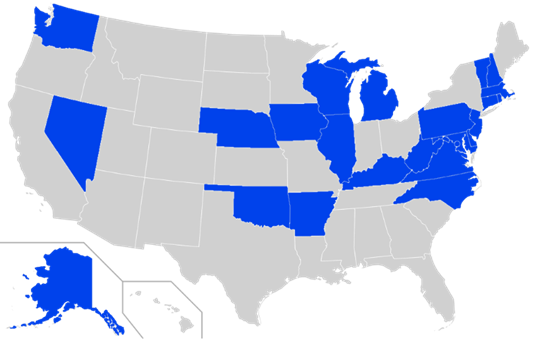
Source: Click here to visit source material.

The expectations of the NAIC Model Bulletin include:

Creating an AI Plan. The Model Bulletin outlines expectations that insurers draft and implement a written program (an “AIS Program”) “for the responsible use of AI systems that make, or support decisions related to regulated insurance practices.” The core focus of the AIS Program is on “governance, risk management controls, and internal audit functions.” As part of the AIS Program, insurers should provide clear notice “to impacted consumers” when AI systems are in use.

Governance Matters. Under the AIS Program, insurers are directed to craft an AI-oversight governance framework, including the formation of a multidisciplinary committee of representatives from across the insurer (product, actuary, data science, legal, etc.) to oversee AI-governance matters.

Risk Management and Internal Controls. The insurer should, as a part of the AIS Program, create and document detailed risk management plans and internal controls with respect to the use, security, and oversight of AI systems (including predictive models), related data practices, quality assurance/validation of data, and proper data retention.

Oversight of Third-Party AI. The AIS Program should detail how the insurer will obtain and utilize: (i) third-party data necessary to develop AI systems; and (ii) AI systems created by a third-party. The insurer should establish appropriate standards regarding thorough due diligence of the third party and external data and thoughtful contracting which create audit rights for the insurer and ensure third party cooperation with any regulatory investigation made into the insurer’s use of the third party’s data or AI systems.

Regulatory Oversight. The Model Bulletin provides categories of information and documentation relating to the use of AI by insurers that companies may need to produce during regulatory inquiries and market conduct actions.

Conclusion

The NAIC’s Model Bulletin, which has been adopted in nearly half of the states and in the District of Columbia, provides an excellent summary of how to craft an AI plan, particularly with respect to today’s state of the art and commonly accepted risk management practices; however, AI governance will be a moving target. The technology is poised to explode, both in terms of use cases and its underlying capabilities. Insurers need to do the difficult work of getting their governance into shape for the here and now, but they should also consider the broader, longer-term impacts of AI, especially on consumer behavior and how consumers access information.

In addition to insurance regulation, states also enforce significant consumer protection laws. It is reasonable to expect that states will follow AI’s impact on the insurance marketplace very closely, examining market conduct through several lenses at once—data privacy, advertising and marketing, product development, to name a few. It might be too early to tell how AI will transform the insurance industry, but with so much information at the fingertips of both insurers and policyholders, there is hardly an area of operation that does not have some kind of AI-adjacent use case that could disrupt the status quo.

Managing these disruptions will require agility, which is hard to come by without a sound governance structure already in place.  Any such structure should bring together all disciplines and units (e.g., business units, product specialists, actuarial, data science and analytics, underwriting, claims, compliance, and legal), each with a well-defined scope of responsibility and authority, chain of command, and decisional hierarchy.

References

[1] Recent federal budget reconciliation legislation, coined the “The One Big Beautiful Bill Act,” initially included a 10-year moratorium on the imposition of state legislation regulating AI. The U.S. Senate stripped the state AI moratorium from the bill in a 99-1 vote. Had the moratorium survived, states would be unable to directly regulate AI, and any existing state AI laws would have been preempted. With federal check on state AI regulation tabled, states are poised to continue their regulation of AI, including state insurance departments, which may leverage the state-by-state structure of insurance regulation to more rapidly regulate AI in the context of insurance.